TL;DR
A 15x15x1 air filter has 225 square inches (1.56 square feet) of face area, enough for about 470 CFM at the 300 FPM limit for 1-inch pleated filters. That fits roughly a 1-ton system. A 2-ton system moving 800 CFM pushes air through one 15x15 return at about 512 FPM, so it needs more return filter area, not a different filter.
Key Takeaways
One 15x15x1 handles about 470 CFM at 300 FPM, or about 310 CFM at the 200 FPM target for MERV 13.
At 400 CFM per ton, a single 15x15 return serves about 1 to 1.2 tons.
A 2-ton system needs at least 2.67 square feet of filter face, such as two 15x15 returns or one 20x20.
Filter depth does not add face area. Only a larger or additional return does.
A whistling grille or a filter that bows inward often signals too little return area.
The quick answer: Divide your system’s airflow in CFM by the filter’s face area in square feet. A result above 300 FPM means the return is undersized. I built the numbers below from a manufacturer’s actual filter dimensions and checked each threshold against ACCA Manual D, Energy Vanguard, and National Comfort Institute guidance, verifying every source on September 16, 2026.
How Many CFM Can a 15x15x1 Air Filter Handle?
A 15x15x1 air filter handles about 470 CFM at 300 FPM. Face velocity equals CFM divided by face area, and a 15x15 face is 225 square inches ÷ 144 = 1.56 square feet.
Put another way, each square foot of filter face handles about 300 CFM at 300 FPM, or 200 CFM at the gentler target for MERV 13. The right target depends on the filter:
300 FPM is the maximum for filter grilles in ACCA Manual D, the Air Conditioning Contractors of America duct design standard, according to a California Energy Commission staff analysis.
250 FPM is a better fit for fine-particle capture on 1-inch media.
200 FPM matches building scientist Allison Bailes’s MERV 13 rule of at least 2 square feet per 400 CFM, detailed in his guide to low pressure-drop MERV 13 filters.
Filterbuy, a U.S. air filter manufacturer based in Talladega, Alabama, uses the same 300 FPM ceiling for disposable pleated panels. For fine particles, it advises aiming lower:
“…nearer 250 FPM if you want fine particles captured rather than driven through the media.”
Source: Filterbuy, air filter sizing guidance (2026)
One 15x15x1 filter can carry this much air at each target:
300 FPM: about 469 CFM, or roughly 1.2 tons
250 FPM: about 391 CFM, or roughly 1 ton
200 FPM: about 313 CFM, or roughly 0.8 ton
What most sizing charts miss: At 200 FPM, one 15x15x1 supports less than a ton of cooling. In my view, a single 15x15 return suits MERV 8 to 11 on almost any ducted system of 1 ton or more, not MERV 13.
How Many Square Inches Is a 15x15x1 Filter, Really?
A 15x15x1 filter has 225 square inches only if its face measures a full 15 by 15 inches. The label is a nominal size, and many filters run smaller. Filterbuy lists its 15x15x1 pleated air filters in MERV 8, 11, and 13 at 15.0 x 15.0 x 0.75 inches actual.
A filter cut to 14.5 x 14.5 inches has about 210 square inches, nearly 7% less. At 470 CFM, that raises face velocity from 300 to about 320 FPM.
Avoid these measuring mistakes:
Measuring the grille faceplate. Measure the filter or rack behind it.
Counting depth as area. A 15x15x4 filter still has a 1.56-square-foot face.
Adding filters in series. A grille filter plus an air handler filter stacks resistance without adding face area.
Missing a return. Add every return filter that feeds the system.
What Size Return Filter Does a 2-Ton AC Need?
A 2-ton AC moving about 800 CFM needs at least 2.67 square feet of return filter face to stay at or below 300 FPM. One 15x15x1 would run about 512 FPM.
Maximum airflow for common return setups at 300 FPM and at the 200 FPM MERV 13 target:
One 15x15 (1.56 sq ft): 469 CFM at 300 FPM; 313 CFM at 200 FPM
16x20 (2.22 sq ft): 667 CFM at 300 FPM; 444 CFM at 200 FPM
16x25 or 20x20 (2.78 sq ft): 833 CFM at 300 FPM; 556 CFM at 200 FPM
Two 15x15 returns (3.13 sq ft): 938 CFM at 300 FPM; 625 CFM at 200 FPM
20x25 (3.47 sq ft): 1,042 CFM at 300 FPM; 694 CFM at 200 FPM
24x24 (4.00 sq ft): 1,200 CFM at 300 FPM; 800 CFM at 200 FPM
Divide CFM by 400 for approximate tons. Nominal sizes; figures rounded.
Why two 15x15 returns can beat one 20x20: On a 2-ton system, two 15x15 returns run about 256 FPM versus about 288 FPM for one 20x20. You also stock a single filter size.
For mixed returns, add the face areas. A 3-ton system (1,200 CFM) with a 20x25 and a 15x15 has 5.03 square feet, or about 239 FPM. The 20x25 alone would run about 346 FPM.
A common contractor rule of thumb gives a similar answer: multiply filter grille area in square inches by 2 CFM. David Richardson of National Comfort Institute explains in Contracting Business’s return grille sizing guide that this keeps grille velocity under 400 FPM. It rates a 15x15 grille at about 450 CFM and shows why a 14x20 grille is too small for a 2-ton air handler.
The 400 CFM-per-ton rule is only an estimate, and Energy Vanguard notes humid-climate systems often run closer to 350. The blower table in your equipment manual, or a technician’s static pressure test, gives a truer number.
Is Your Return Air Filter Too Small? Check These Symptoms
An undersized return usually shows up as a whistling or humming grille. Air forced through too little filter area moves fast and builds resistance, which starves the blower. Also watch for:
A filter that bows, pulls into the rack, or shows dust streaks around its frame.
Filters that look loaded within weeks.
Weak supply airflow and long run times.
Ice on the indoor coil during cooling.
Static pressure confirms the problem. Many residential furnaces are rated at 0.5 inches of water column, and Energy Vanguard’s roundup of high-MERV filter research reports National Comfort Institute testing found average systems near 0.82 inches.
What Should You Rule Out Before Blaming the Return?
Rule out cheaper causes first, because a clogged filter or blocked grille can mimic an undersized return.
Replace a dirty filter. The DOE’s Energy Saver 101 home cooling guide says routine filter changes can lower AC energy use by 5% to 15%. Our furnace filter replacement guide walks through the swap.
Match MERV to the slot. In California Energy Commission lab tests, 2-inch MERV 13 filters generally had lower pressure drop than 1-inch versions. Our MERV ratings chart guide explains the ratings.
Clear the path. Move furniture off grilles and open closed registers.
How Do You Fix an Undersized 15x15 Return?
Fix an undersized return by adding filter face area or reducing resistance:
Add a second return. Two 15x15 returns carry about 940 CFM at 300 FPM.
Enlarge the grille, for example from 15x15 to 20x20.
Install a 4- or 5-inch media cabinet at the air handler for lower pressure drop.
Dropping to a lower MERV rating reduces resistance but captures fewer fine particles, so treat it as a stopgap.
Does Return Size Matter When You Add a UV Light?
Yes. UV-C lamps treat microbes on the coil, but the return filter controls how much air and dust reach it. The Air-Conditioning, Heating, and Refrigeration Institute (AHRI) names the coil and drain pan as the preferred lamp location. It also warns that lamps upstream of the filter can collect dust and that UV exposure can degrade non-fiberglass filters.
My advice for UV light buyers: Make a static pressure check part of the UV quote. A clean coil on a starved return still runs below its rated airflow.
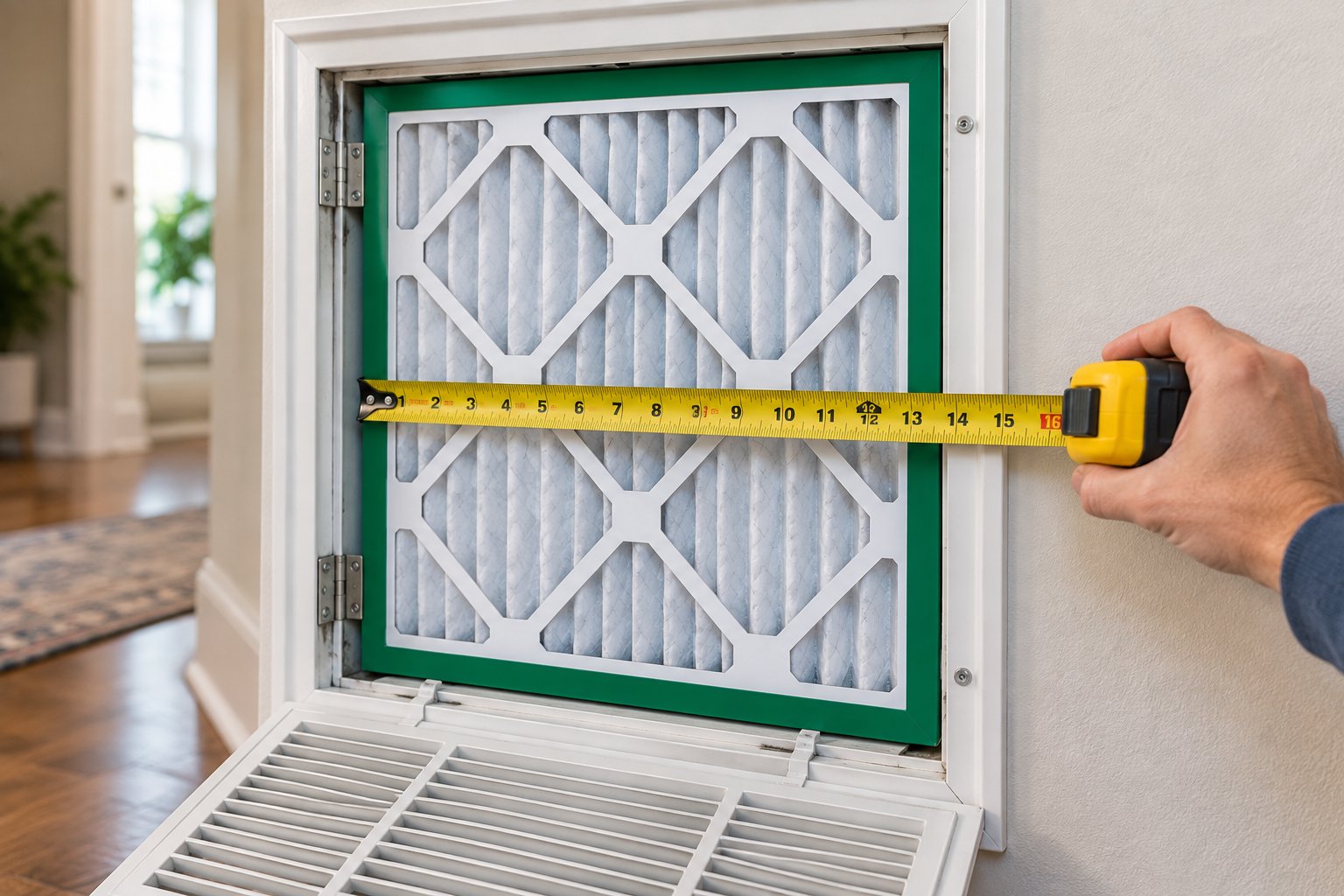
“The filter gets blamed for problems the return grille creates. Measure the face area first, then pick the MERV rating.”
- Filterbuy
Essential Resources for Choosing, Sizing, and Maintaining a 15x15x1 Air Filter
Pick a MERV rating: EPA, Guide to Air Cleaners in the Home
Read MERV labels: NAFA, Understanding MERV user guide
Size a filter for MERV 13: Energy Vanguard, The Path to Low Pressure Drop Across a High-MERV Filter
Check a return grille: Contracting Business, Four Return Grille Traits You Should Never Ignore
Compare filter resistance: California Energy Commission, Staff Analysis of Air Filter Pressure Drop and Air Filter Sizing
Maintain your system: ENERGY STAR, Maintenance Checklist
Hire a contractor: ENERGY STAR, 10 Tips for Hiring a Heating and Cooling Contractor
Supporting Statistics
Three U.S. government findings show how filter efficiency, filter depth, and airflow affect a small return.
50%: MERV 13 and higher filters must remove at least half of the smallest test particles, which is why the EPA recommends MERV 13 or the highest rating your system can accommodate.
About 30%: In California Energy Commission tests, the best 2-inch MERV 13 filter moved about 30% more air at 0.1 in. w.c. than the best 1-inch version. Same-size MERV 13 filters ranged from under 400 to about 1,000 CFM.
Up to 15%: ENERGY STAR reports that airflow problems can reduce system efficiency by as much as 15%.
Final Thought & Opinion: Size the Return Before You Shop for the Filter
Weak airflow usually gets blamed on the filter. Homeowners swap brands or drop from MERV 13 to MERV 8, yet neither move adds a square inch of face area. Start with how much air the system moves and how much filter face it has, and the right MERV rating follows.
Next Steps: How to Check Your 15x15x1 Return
Check a 15x15x1 return in five steps, and let the face velocity result decide what you buy or fix.
Gather your numbers. Find tonnage in the outdoor unit’s model number (on many brands, 024 means 2 tons), then add the actual face area of every return.
Run the math. Divide CFM by total square feet of filter face.
Act on the result. At 200 FPM or less, choose MERV 13. From 201 to 300 FPM, use MERV 8 to 11 in a 1-inch slot and test static pressure before upgrading. Above 300 FPM, plan to add return area.
Hire for measurements. Use ENERGY STAR’s contractor hiring tips and ask for static pressure, measured airflow, and itemized estimates.
Check filters monthly. Keep spares in the exact actual size and MERV rating you chose.
Frequently asked questions
How many CFM per square foot of filter is safe?
A common limit is 300 CFM per square foot of filter face, which equals 300 FPM for 1-inch pleated filters. For high-MERV filtration, Energy Vanguard recommends about 200 CFM per square foot (2 square feet per 400 CFM).
Can I use a MERV 13 filter in a 15x15x1 return?
A MERV 13 15x15x1 filter works best when airflow through it stays low, around 310 CFM or less at Energy Vanguard’s 200 FPM target. On a 2-ton system with a single 15x15 return, a 1-inch MERV 13 filter is likely to add too much resistance, so check static pressure first. If MERV 13 proves too restrictive, manufacturers such as Filterbuy also make the 15x15x1 in MERV 8 and MERV 11, so you can step down without changing the filter size.
Will a thicker filter fix a small return?
A thicker filter lowers resistance by adding pleated media, but it does not change face velocity, because a 15x15 face stays 1.56 square feet at any depth. A deeper filter also needs a slot or cabinet built for that depth.
Can two 15x15x1 returns replace one larger return?
Yes. Two 15x15x1 returns provide 3.13 square feet of face area combined, which carries about 940 CFM at 300 FPM, enough for a typical 2-ton system.
Is the “2 CFM per square inch” rule the same as 300 FPM?
The 2 CFM per square inch contractor rule is close to 300 FPM. It gives a 15x15 grille about 450 CFM, or roughly 288 FPM, and Contracting Business notes it keeps grille velocity below 400 FPM.
Glossary
CFM (cubic feet per minute): CFM is the volume of air an HVAC blower moves each minute.
Face velocity (FPM): Face velocity is airflow in CFM divided by filter face area in square feet.
Nominal vs. actual size: Nominal size is the rounded label size; actual size is the filter’s measured dimensions.
Static pressure: Static pressure is the resistance air meets moving through ducts and filters, measured in inches of water column.
MERV: MERV is the 1-to-16 filter efficiency rating defined by ASHRAE Standard 52.2.
Filterbuy: Filterbuy is a U.S. air filter manufacturer based in Talladega, Alabama that makes pleated HVAC and furnace filters, including the 15x15x1 in MERV 8, 11, and 13.
Learn more about HVAC Care from one of our HVAC solutions branches…
Filterbuy HVAC Solutions - Weston FL
2573 Mayfair Lane Weston FL 33327
(754) 296-3528
https://maps.app.goo.gl/E3tjmKf5VSWYghGc7